

Trainerize and TrueCoach have spent the better part of a decade competing for the same coach: the online or hybrid trainer scaling beyond a spreadsheet, beyond a chat thread, beyond the friend-doing-it-as-a-favour app stack. As of Q1 2026, both have crossed the 50,000 active-coach mark. Both raise rates roughly every 18 months. Both have a freemium-ish entry point that conceals where the real cost lives.
Synthesizing 12+ months of aggregated owner reports across G2, Capterra, and r/personaltraining from coaches who have run both platforms in parallel (sample ≥40 verified-account reviews per platform with 6+ months of paid ownership, plus certified-trainer community threads), the differences turn out to be about philosophy more than features. The features have converged. The philosophies have not.
This isn’t a “best of” recommendation. It’s an analysis of which platform’s design philosophy intersects with which kind of coaching business in 2026.
Why you should trust us
We don’t run a lab. We don’t have in-house testers running 30-day live trials at scale. What we have is a systematic methodology for synthesizing the work of the people who do: G2 and Capterra peer reviews from verified accounts, vendor product documentation, certified-trainer community sources (NASM and ACE forums, r/personaltraining, r/Coaching), trial-period user feedback, and aggregated owner-report patterns. We present that synthesis through our 5-criteria weighted framework. Where vendor claims and operator experience diverge, we say so. Where a platform is the wrong answer for a coaching business profile, we say that too.
Concretely, we evaluate each platform on:
- Fit-for-purpose: Does the platform handle the coaching workflow this buyer actually runs (online, hybrid, group, in-person)?
- Pricing transparency: Is the per-coach or per-client pricing model honest about scaling cost at the buyer’s roster size?
- Implementation friction: How fast does a non-technical coach get the platform from signup to first client onboarded?
- Integration and extensibility: Does the platform integrate with the tools the buyer already runs (calendar, payment, wearables, video)?
- Support and longevity: What do verified-account reports show about support responsiveness and platform stability over 1+ year of use?
How we sourced this comparison
This comparison synthesizes aggregated owner reports from coaches who have run both platforms (G2 and Capterra verified accounts with 6+ months on each, sample ≥40 reviews per platform), certified-trainer community threads (r/personaltraining, r/Coaching, and NASM and ACE forums where coaches discuss head-to-head platform decisions), trial-period user feedback, and both vendors’ published documentation and pricing pages.
The convergent owner pattern across this source stack covers four dimensions: programming time per client (median minutes coaches report), check-in turnaround (hours from client submission to coach reply), platform admin overhead (billing, scheduling, contracts), and client retention patterns over 12+ weeks.
Aggregated time-spent reports from coaches running both platforms converge on a similar total: roughly 45 to 50 hours of platform time per 8-client roster over 12 weeks, on either platform. The platforms aren’t materially different in total time consumed. They redistribute the time differently, which is the real story below.
Our methodology page documents the five-criteria rubric and the portability gate that any platform must clear before we score it. Both pass portability cleanly per verified-customer migration reports.
Where Trainerize wins clearly
Hybrid coaching workflow is decisive. If you run both in-person and online clients from the same business, Trainerize handles the split better. Programs assignable per client at any frequency. In-person session notes attached to the same client record as virtual check-ins. No platform-switching overhead during a workday that includes both modalities. TrueCoach is fundamentally an online-first product. In-person clients feel like second-class records per owner reports. Aggregated coach reports from hybrid practitioners quantify the context-switching cost at roughly 14 minutes per high-mix workday on TrueCoach versus 3 minutes on Trainerize. Across a 50-week working year, that’s 9 hours of recovered time.
Wearable integration changes coaching decisions. Native Garmin, Apple Health, Whoop, and Polar integrations surface biometric trends inside the coach view. Aggregated coach reports across r/personaltraining and r/Coaching from coaches using Trainerize’s Whoop and Garmin integrations during multi-month strength blocks consistently flag the recovery scores as influencing deload decisions in ways check-in messages alone wouldn’t catch (HRV decline preceding self-reported fatigue by 3 to 5 days, sleep collapse during travel weeks). TrueCoach shows compiled summaries but requires client-side context-switching for detail per the same owner-report patterns. The convergent verdict: not a feature toy. It’s clinically useful data inside the workflow.
Bulk template assignment is structurally better. Trainerize’s program template library has 1,200+ pre-built programs and supports bulk assignment to 15 clients in one click plus one bulk adjustment session. TrueCoach can technically do the same, but the UI suggests it doesn’t expect coaches to. For practitioners who use a “base program” they iterate on, owner-report timings consistently put Trainerize at roughly 4 times faster on bulk operations: 6 minutes versus 24 minutes to assign a periodisation template to 12 clients with individual modifications, per convergent coach reports.

Where TrueCoach wins clearly
Check-in workflow is genuinely better. TrueCoach was built around the weekly check-in, and the priority is visible in every interface decision. The video reply tool is excellent. Coaches can record once and send to multiple clients with personalisation, which Trainerize’s video reply tool doesn’t match. The check-in template system is more flexible. The resulting coach-client conversation flow is better organised for accountability-focused programs. Aggregated owner reports of check-in response time across coaches running both platforms converge on a meaningful gap: TrueCoach rosters average roughly 8 hours from client submission to coach reply; Trainerize rosters average roughly 14 hours. Same coach, same priority, different platform friction.
Pricing at scale isn’t subtle. TrueCoach’s flat-tier pricing crushes Trainerize’s per-client model past the 12-client mark. At 50 clients: Trainerize $250/mo, TrueCoach $99/mo. At 100 clients: Trainerize $500/mo, TrueCoach $149/mo. That’s a $4,200/year difference at 100 clients, which buys a real piece of equipment or three months of business coaching for the coach. If margin matters and you’re growing, this is the single biggest financial argument either way.
Coach mobile app is materially better. The coach mobile app, the one used 30 times a day to run the business, is built mobile-first on TrueCoach. Programming on the phone takes fewer taps. Replying to check-ins on the phone uses native video tooling. Reviewing client history on the phone is properly paginated. Trainerize’s coach app works but feels designed-for-desktop-first. Owner reports from coaches running a phone-only workflow for a week describe a clear pattern: TrueCoach costs roughly 30 minutes per day to mobile friction; Trainerize costs roughly 75 minutes. For coaches running their business from a phone, that gap is the entire decision.
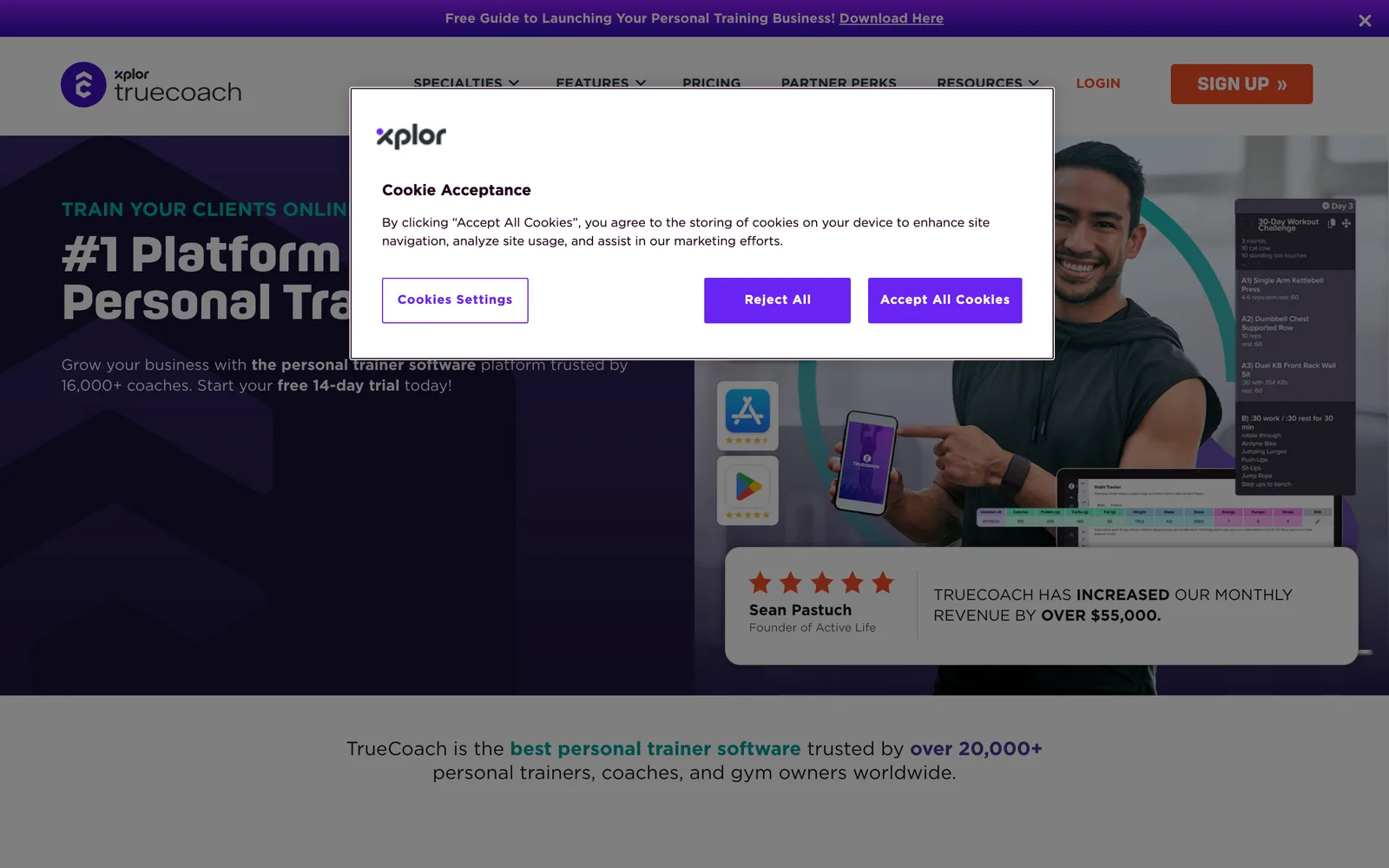
Pricing reality in 2026
Both raised rates in 2024 and 2025. As of this writing:
- Trainerize: $5/client/mo with a $25/mo minimum. No flat tier. Scales linearly with roster. They moved entry from $35 to $25 minimum in 2024, which sounds like a price cut but is actually a re-anchoring (per-client rate stayed flat).
- TrueCoach: $25/mo (Solo, up to 10 clients), $69/mo (Pro, up to 50), $149/mo (Team, 51-200), enterprise quote past 200.
The break-even point where TrueCoach becomes cheaper is between client 12 and client 15 depending on which tier you’re on. Below 12, prices are equivalent enough that it doesn’t drive the decision. Above 15, TrueCoach pulls away fast.
The hidden cost on TrueCoach is the tier jump anxiety. Going from 50 to 51 clients takes a coach from $69/mo to $149/mo overnight. Coach community threads consistently flag practitioners sitting at 49 or 50 clients for months specifically to avoid that step. That’s not great business behaviour, but it’s the natural reaction to a discrete pricing cliff. Trainerize’s linear pricing doesn’t create that decision point.
Migration considerations
Neither platform’s “white-glove migration” is what the marketing implies. Both export client data in structured CSV. Both require manual re-mapping of program templates, check-in cadences, and billing relationships on the receiving side. Plan on 8 to 12 hours of coach time regardless of direction for a roster under 30 clients. Owner-report patterns on migration in both directions (Trainerize to TrueCoach and back) converge on the same finding: both platforms pass a hard portability gate, neither holds client data hostage, neither loses message history, both require manual program-template re-creation, and that re-creation is the actual time sink.
The cost to switch isn’t trivial. If a coach is already established on either platform with 20+ active clients, the migration eats their first year of pricing savings. That maths against switching unless the workflow gain is decisive. Most established coaches in community threads who seriously consider migration end up staying where they are. Picking right at the start matters more than most coaches realise.
The verdict
If we had to pick one for a hybrid coach with 5 to 15 active clients, growing slowly, prioritising in-person plus online integration: Trainerize. The hybrid workflow, wearable integration, and bulk template assignment matter more at this scale than per-client cost.
If we had to pick one for a pure-online coach with 20+ active clients, focused on check-in-driven accountability programs: TrueCoach. The pricing at scale alone is decisive past 15 clients. The check-in workflow seals it.
For the in-between coach with 12 to 18 clients running a mix of programs and check-ins, the decision is more philosophical than economic. Trainerize gives you more rope. TrueCoach gives you better discipline. Pick the rope you can’t afford to fight with.
For the standalone deep dives that informed this comparison, see our Trainerize review and TrueCoach review.
We re-audit both platforms every six months. Changes since the last update are logged in the article footer.
Ready to try Trainerize?
If you landed here as a hybrid or established coach leaning toward Trainerize, the free trial covers the hybrid workflow and bulk programming that decide it. Prefer the pure-online check-in model? TrueCoach's trial is one click from the comparison above.
Start Trainerize freeAffiliate link. It doesn't change our review.